Perhaps this feels familiar
In your core you often feel wrong, foreign or insecure.
You’ve recognised patterns in your relationships – and repeat them anyway.
You’re exhausted, yet can’t truly come to rest.
Therapy – who can benefit and how
I offer therapy for people who
- are at a turning point in their life or in the middle of a crisis
- feel resigned, burdened or without joy
- deal with anxiety
- are confronted with contact problems, interpersonal conflicts, break-ups
- are on the verge of bursting with anger, but stay polite and well-behaved
- want to feel more connected and alive
- feel like rediscovering themselves and trying out new ways
- need a space to clarify current problems in peace
- wish a deeper, more satisfying life for themselves
- want more fulfilling relationships with others
- want to develop good self-esteem
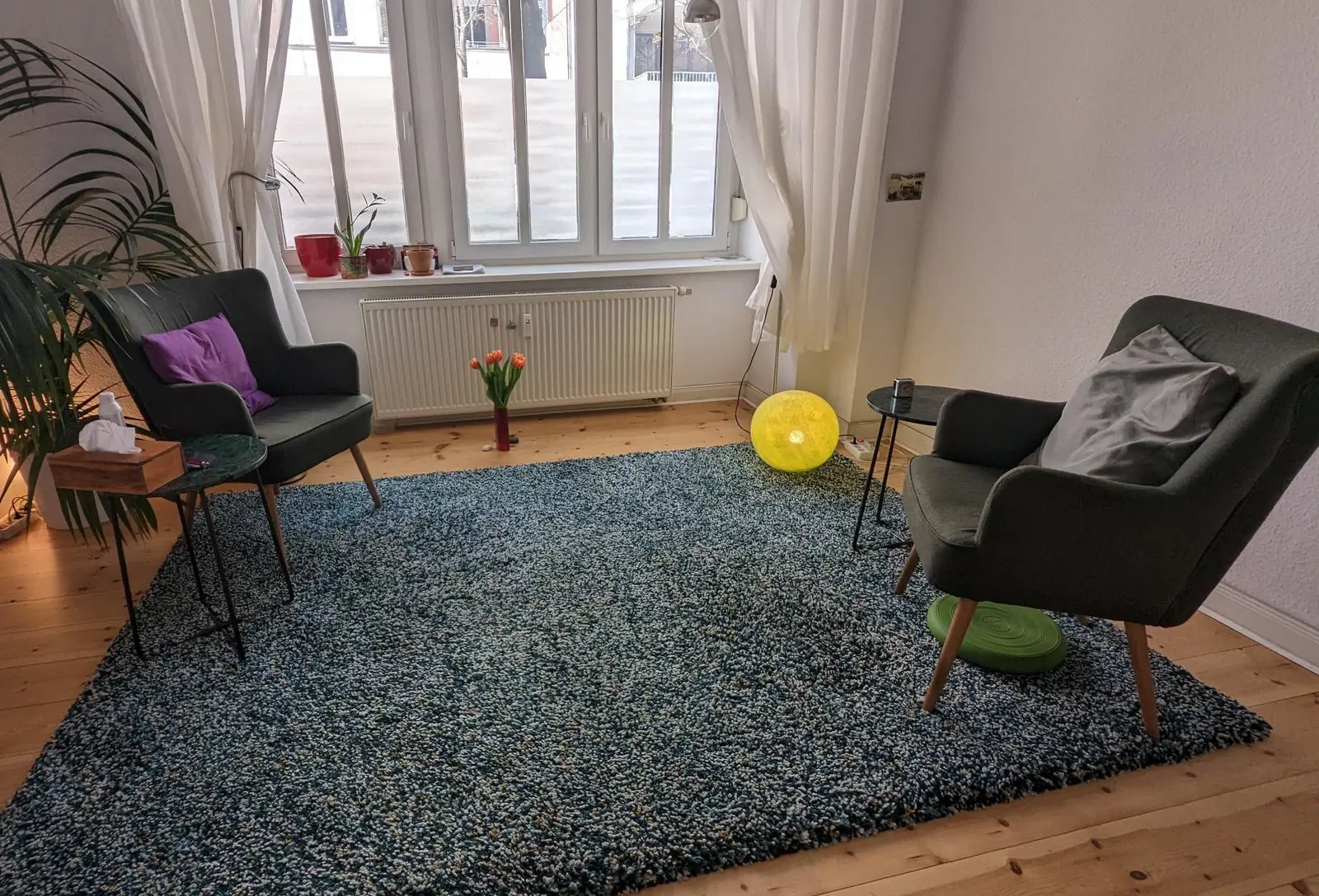
The body as a bridge
Alongside all its other tasks, the body always serves as a bridge: to experience, to the next impulse, to expression, and to learning new capacities.
Especially when our thoughts go in circles, the body can show us new paths and open doors – at your own pace, in the space we share.
I work body-oriented and trauma-informed. Change comes not only through understanding, but through new experiences – in the body, in the moment, in relationship.

Daniel Holbach
I am a Heilpraktiker für Psychotherapie and have had my own practice in Friedrichshain since 2019. Born 1979, in Berlin since 2005 – my working life began as a software engineer in open-source communities.
I know the fast-paced working world, the running on empty, and the path back to yourself. That’s why I bring genuine interest to this work – not just professionally.
- Heilpraktiker für Psychotherapie (2017)
- Somatic Experiencing® Practitioner – full member of SE Deutschland e.V.
- Body-Oriented Psychotherapy – 4-year training
- Candidate member DGK & EABP
- Regular supervision, intervision & self-experience
What a session is like
We talk – and we can also follow the body's story. Much of that happens sitting down, and your eyes can be open or closed. Sometimes we stand up for a small experiment: something for grounding, or a movement. And sometimes we explore what shifts in the body when you're in a particular state. If you're torn between two options, say – what happens inside when you try on “stay”? And what happens when you try on “leave”?
Touch isn't a major focus in my work these days – and it only ever happens if you want it to. Sometimes it's a supportive gesture, a hand on your arm. Sometimes I offer resistance when you have the impulse to push something away, so the movement can complete. And if you'd rather not, that is completely fine – it will not change anything about how we work.
When we work with anxiety, trauma or other stressful states, we look at the charge held in the system – gently, in small steps. Resourcing, orientation and grounding are the foundation we work from, and from there it is much easier to lean into whatever the current challenge is.
It wouldn't be right to promise that the process is always pleasant and always gentle. We may find ourselves dealing with a bigger wave of charge than expected – a moment where you feel somewhat overwhelmed, or cut off from yourself. We work with that too: we practise finding the way back out, and take the time to land and integrate the experience. That is exactly what builds confidence for situations outside the therapy room. An image from my SE training puts it well: then we try to ride the wave.
I try to keep the work practical and connected to everyday situations, so it's easy to carry on with between sessions: a journal, a letter to yourself or to a younger part, a plan for the week. Whatever you need at the time. A lot of the work that really matters happens between sessions.
How I work
If you'd like, a little more depth – what body psychotherapy, Somatic Experiencing® and parts work actually involve. I've written articles on two of them, and two have a fuller page of their own – the links are inside each section.
And if it isn’t about medical treatment?
For concerns outside medical treatment – clarity and next steps.
See the coaching offerGood to know
People of every age, gender, sexual identity and background are welcome here.
I work as a Heilpraktiker für Psychotherapie (§ 1 Abs. 3 HeilprG) – not as a state-licensed psychotherapist.
Psychotherapy covered by statutory health insurance usually involves a long run-up and an approval process, and a diagnosis of clinical significance has to be established and confirmed. None of that is required here – we can simply start.
As long as you pay for the sessions yourself, no diagnosis is reported to a health insurer either. For some people that matters, with an eye on things like occupational disability cover.
In an acute crisis, or if there is immediate danger to life, please contact emergency services or a crisis line straight away. I have collected the most important numbers here:
Emergency and crisis numbersCommon Questions
Curious whether we’re a fit?
Get in touch – in a free intro call we can find out together whether we might work well together.
Directions & first contact